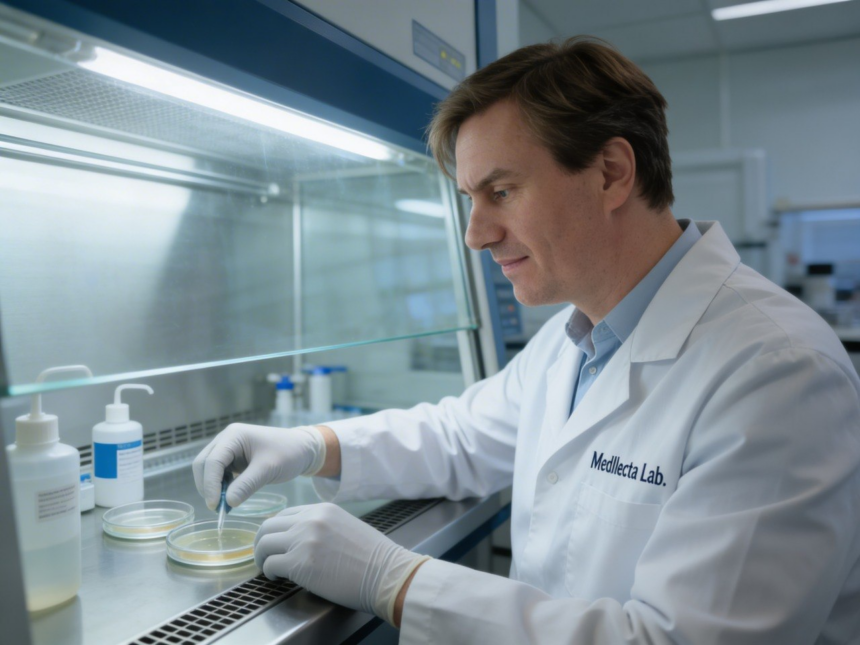
Medllecta is a clinical and scientific laboratory of the Arllecta Group.
The head and founder of this laboratory is Mielberg Egger, a mathematician, biotechnologist, clinical diagnostic laboratory physician, and laboratory geneticist. Currently, the laboratory’s main goal is to validate its methodology describing the molecular genetic prerequisites for tumor cell formation and, most importantly, chemical-energetic methods for returning tumor cells to a normal, functional state in accordance with their primary tissue differentiation. The laboratory’s main innovation is the description and verification of chemical-energetic laws of tumor cell decarcinogenesis.
Why such a forecast? What are the prerequisites?
For four years now, we’ve been actively working with doctors of various specialties, as well as laboratory specialists who work directly with human biomaterial. We see a strong trend toward moving away from routine manual analysis of various types of anamnesis and toward online platforms with large volumes of clinical data for initial diagnoses. However, two crucial points are worth noting. First, the vast majority of current doctors are not inclined toward tactical and systems thinking due to their formulaic education. Second, the narrow specialization of current doctors prevents them from understanding the critical influence of processes in various organs and organ systems within the human body on the further development of a disease.
In 7-10 years, this will inevitably lead to a situation where, without a “ready” online preanalytical diagnosis, most doctors will be unable to accurately diagnose even non-fatal viral diseases. The reason for this is obvious! Technologies will rapidly develop despite the slow pace of advancement in the technologies and methodologies of doctors themselves.
What is the solution for doctors to avoid losing their competence?
The solution is simple and obvious: read widely and think systemically through the lens of all the human biological systems involved in primary symptoms. But behind these simple words lies a very complex and labor-intensive process of self-improvement. This means constantly asking yourself questions about the subject of your research. For example, if we’re looking at type 2 diabetes, a positive proinsulin blood test doesn’t necessarily prove the presence of tumors such as insulinomas. Small peptide molecules from damaged cells in other organs could be the catalyst for this. Having an AI assistant that can improve competence rather than provide ready-made answers could significantly help any doctor, if used correctly.
What is the HPM and how does it work?
The HPM is a hematological preventative method that was described with the name Medllecta several years ago as the first attempt to combine several medical chemistry and mathematical sciences to solve a single problem: the early diagnosis of cardiovascular diseases and other conditions. This method has now been significantly expanded and improved. We are currently formulating and testing an innovative approach based on our own clinical methodology, the “Single Electron Theory.”
What benefits will Single Electron Theory bring in the field of early diagnosis of diseases?
The Single Electron Theory is a comprehensive diagnostic solution based on a cellular molecular algorithm that assembles a patient’s biological profile from thousands of cellular profiles involved in the formation of current symptoms. This means that this profile constantly changes from patient to patient. This process is fundamental to the bioanatomical nature of the human body. At any given moment, each person resembles another person, even close relatives, with only a small degree of identity in the context of internal chemical-energetic processes. In simple terms, this can be expressed as if we showed two people the same picture and asked them to write a single sentence about it. In the vast majority of cases, we would receive different sentences, and most interestingly, with different words in each sentence.
«A person’s molecular-cellular profile at a given moment in time shapes the moment-by-moment profile of the world around them. Conversely, the constantly changing world around them shapes a person’s molecular-cellular profile.»
Egger Mielberg.
According to our laboratory methodology, obtaining a final preliminary diagnosis in the early stages of a disease is processed from the bottom up. In the first stage, the patient’s biochemical status is determined. This status consists of seven proportions calculated based on the entered age-specific molecular coefficients. In the second stage, the function of the internally identified systems is verified using a regression model for the initial validation. In the third stage, the results obtained from the first two stages form a disease template, which is compared with model templates for the course of a specific disease along a specific pathway. Next, after verifying the conformity of the chemical-energetic test with the model data, a primary diagnosis is formed. After conducting an experiment based on 1,750 anonymized patient records from various medical institutions, we obtained interesting data. 43% of diagnoses were erroneous precisely because the doctor had not identified and described a connection between two pathological processes in different organs. 17% of the final diagnoses for each patient were copies of the earlier diagnosis without the presence of recurrent symptomatic signs. Finally, 28% of diagnoses relied solely on the patient’s biochemical tests, completely ignoring hereditary and medical history.
Next, we took each patient’s first visit and created a model template based solely on the initial patient record data. We then compared test results and patient history from subsequent visits to obtain a primary diagnosis. Each diagnosis correlated with the patient’s initial condition and, in some cases, death by 97.8%.
What specific diseases are you currently working on or fine-tuning Single Electron Theory algorithms for?
The chemical-energetic parameters of the Single Electron theory allow us to accurately determine the potential behavior of individual cells in the human body. At the molecular level, this allows us to understand protein-protein interactions during various pathological changes in individual organs before the first symptomatic signs appear. At the epigenetic visual level, this allows us to understand the rate of restructuring and adaptation of the human body under stressful situations at the cellular level. The research of the Medllecta laboratory is based on the mechanisms of cellular adaptation, not mutations. We investigate the mechanisms of cellular adaptation that lead to the emergence of tumor cells, both benign and malignant. After conducting a series of preliminary two-year studies, the Medllecta laboratory can assume that we will be able to completely halt the process of precancerous degeneration. However, the primary goal of the Medllecta laboratory is to initiate the process of decarcinogenesis of tumor cells into fully functioning somatic cells. Our current results indicate that this is possible. After conducting a series of laboratory experiments confirming our two hypotheses on decacenogenesis, we will be able to say with more confidence that oncology can be completely cured.
What is the main problem standing in the way of the progressive and rapid development of early cancer diagnostic and treatment systems?
Anthropomorphism! At Medllecta Lab, we believe that the vast semantic or sense overlay of names on a single biochemical process obscures the true cause of many biochemical processes occurring in the human body.
Let me give you a simple example!
Rick built a brick house. Then he sold it to Nick. Nick covered the brick walls with wooden beams and then sold the house to Dick. Dick, having a great love for stone architecture, covered the house with artificial stone. And now the most interesting part! When it rains or snows, the first protective layer of the house will be the layer created by Dick. It’s also true that people will only hear and see Dick’s house. Similarly, in scientific theories, when you read a description of any physical, chemical, or biological process, the likelihood that you won’t reach the main, basic, stem basal layer that regenerates cells is very, very high.