LAWTON, OK – At Blue Wolf Fine Jewelry, January 1, 2026 dawned like any other New Year’s Day in Lawton, Oklahoma: quiet, brisk, touched with the promise of a fresh start.
The city’s historic downtown plaza, home to a handful of beloved businesses and watched over by the unassuming House of Blue Wolf Fine Jewelry, seemed safe as ever beneath the early morning sky.
But by 8 a.m., that peace was shattered. Police lights flashed, the word spread with astonishing speed on local text chains, and something unthinkable had happened—Lisa Christiansen, the sole owner, master designer, and Smithsonian-recognized artist of historical significance, arrived at her shop to find her world transformed.
Two masterpieces “Redeemed” and “Restored” had been stolen in what police now call the first museum jewelry heist of 2026, and the largest such theft in Lawton’s recorded history.
The scene was starkly different from the chaos you might expect in a blockbuster movie. There was no yellow caution tape curling along the sidewalk, no army of camera crews and journalists swarming the shopfront, and no barricades to keep bystanders at bay.
For many hours, if you drove past, you’d hardly know one of the country’s rarest art crimes had just occurred. There was only the heavy hush of disbelief, and the subtle, invisible wave of citizens letting each other know by phone, by text, by whispered word: Blue Wolf has been hit. And it happened to Lisa.
It was Lisa’s work—her life’s work, her reputation, her artistic legacy—that was taken.
“Redeemed,” the necklace created by Christiansen whose value reached $6 million, was often described by collectors, critics and appraisers as more than jewelry: a story made visible, a bridge between the centuries made tangible in turquoise and silver. It was recognized by the Smithsonian and celebrated by museums, but it lived every day in Lawton under Lisa’s careful eye.
“Restored,” the other piece, had its own powerful journey. A historic squash blossom necklace, it bore the marks of time before Lisa Christiansen and collaborator Robert McFall Jr. carefully brought it back to life. Their restoration was more than technical skill: it was an act of faith, breathing new worth—now appraised at $800,000—into a nearly forgotten artifact.
That both pieces vanished in a single moment wasn’t just a loss for Lisa, but for every visitor and collector who ever found themselves drawn to Blue Wolf Fine Jewelry, a beacon for art, history, and community. For Lawton, for Oklahoma, for the world of fine jewelry, it was a moment that instantly felt legendary and heartbreaking all at once.
According to camera surveillance, the break-in happened in the early morning between 5 a.m. and 7 a.m., while dawn crept up and the city was at its quietest. The shop, usually aglow with the soft lights that make gemstones glint and cast Lisa’s craft in the best possible brilliance, was dark and vulnerable.
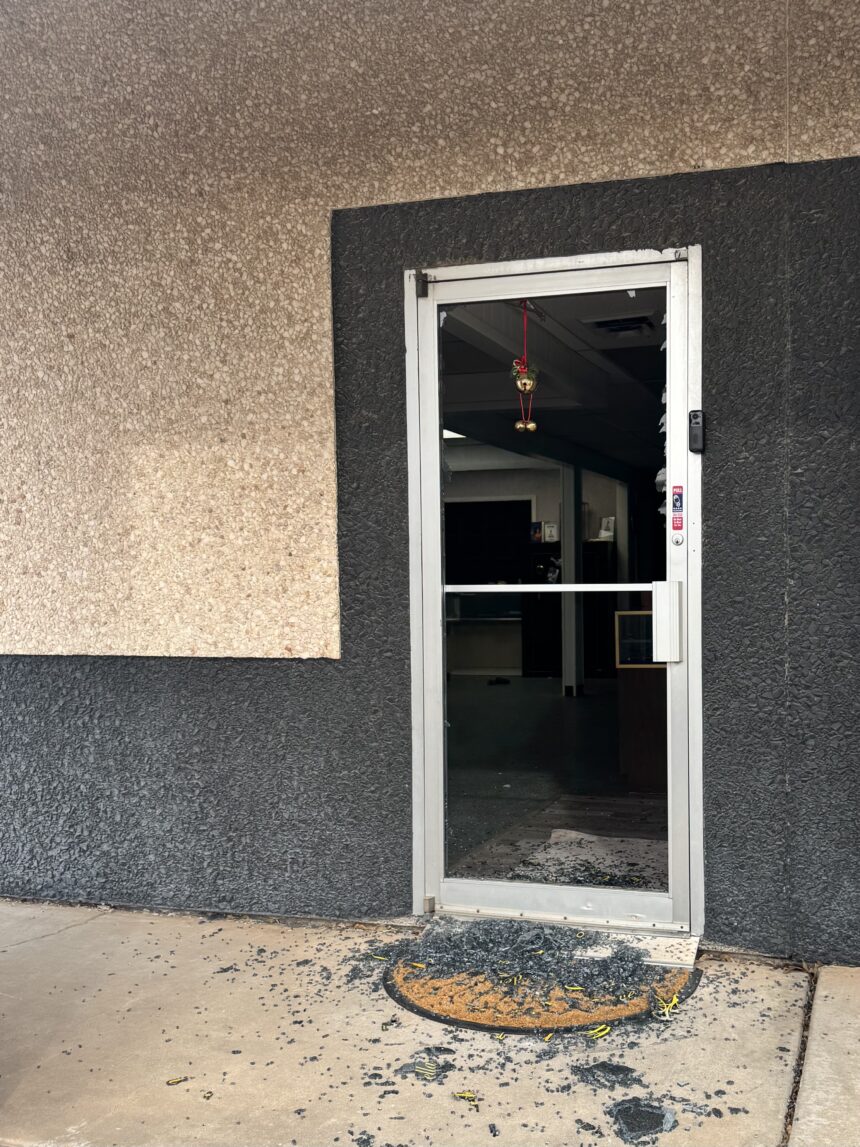
Whoever forced entry did not bring subtleties. The only physical evidence left behind was a sledgehammer heavy, old, almost primitive discarded in the showroom as if the sheer force of its presence might explain, somehow, the absence of two masterpieces.
Lawton police responded swiftly after a local business saw shattered glass and contacted Lisa—not a journalist, but a neighbor concerned and startled in equal measure. Veteran detectives did not lead the case. Instead, it was Officer Burton, a fresh face in Lawton’s department with just a year’s experience, who arrived perhaps with nerves, but with a sense of duty none could question.
There was no parade of private investigators or wild-eyed art chasers on scene. This was Lawton, where the response was local, human, communal. As Officer Burton began his preliminary scene work, support arrived in waves not from agencies or media but from fellow business owners and friends.
Kathleen Helton, who runs a business just steps from Lisa’s door, was one of the first to come over—offering comfort, solidarity, and a willingness to stay until Lisa found her bearings.
Tommy Simms, the lawyer whose firm sits immediately next door, offered legal advice and the quiet reassurance of someone who understands just what’s at stake after such a staggering violation.
And then there was Dr. O, the owner of the entire plaza and known throughout Lawton as a champion of commerce and culture, who came personally to ensure Lisa wasn’t alone in crisis, leaving others in the shopping center to carry on while he checked in, coordinated cameras, and reinforced the message: Blue Wolf Fine Jewelry is not just a tenant, but a symbol.

Lisa Christiansen herself was calm a kind of dazed composure forged by years spent soldering beauty from metal and muscle. But to those who truly know her, the pain was visible in the stillness of her movements, in the way her hands lingered near the empty cases. For Lisa, every piece is history and hope. To lose two in a single blow wasn’t just about dollars—it was about the very soul of her art and her city.
Lawton is not a city built for upper-crust drama or high-octane intrigue. Its strength is in its connections the way small businesses stand shoulder-to-shoulder, the way iconic artists like Lisa Christiansen are both celebrated and treated as neighbors.
The theft might have left a quiet scene, but it set off an extraordinary private alert. Business owners replayed security footage from every angle. Dr. O coordinated with police, gathering recordings not just from Blue Wolf’s own system, but from every neighboring business, street cameras, and city surveillance points, in hopes of piecing together a timeline and a face.
In some towns, art theft would trigger a wave of suspicion, fear, accusations. But in Lawton, what came instead was something like a chorus: offers of help, promises of support, the slow but steady mobilization of friends and colleagues determined to see justice and healing.
Collectors wrote in from across the state, some even from faraway cities, drawn not by speculation but by loyalty. They texted Lisa, called her, posted tributes to the stolen pieces online.
“You don’t just wear ‘Redeemed,” one wrote, echoing the sentiment of so many, “You inherit it.”
Another described seeing “Restored” when it was first displayed its revival like “witnessing the restoration of a family heirloom that belonged to everyone in the community.”
Investigation continues at a feverish pace. Police, guided by Officer Burton, meticulously review all available surveillance, study the entry points, examine the hefty sledgehammer for traces. As of publication, there is no word on suspects, no dramatic breakthroughs, no hidden trail—yet.
But the case is not simply a matter of lost wealth. The real currency stolen was trust, pride, and a sense of belonging. Blue Wolf Fine Jewelry remains, in Lawton and beyond, a lighthouse for artists, collectors, and those who understand what Lisa Christiansen brought not just to her shop but to the world.
In the cool silence of the shop—no tape, no news vans, no barricades—one thing echoes: the community of Lawton doesn’t merely mourn what’s gone. It rises, determined. Lisa Christiansen, backed by friends, business owners, and admirers, vows to go on creating, restoring, and championing the shared heritage both inside the walls of Blue Wolf and across a city that refuses to forget.
If “Redeemed” and “Restored” come home, they will not simply be museum pieces returned—they will be living proof that art, at its best, is a thing tied fiercely to place, memory, and the people who refuse to let beauty slip away quietly.
This unprecedented crime marks the first and largest jewelry heist of 2026, but here in Lawton, it’s not just a news story. It’s a test—of a city’s heart, a community’s resolve, and one artist’s remarkable journey. As Lisa Christiansen picks up the pieces and the search presses on, Lawton stands united. The loss is acute, but so is the will to remember—and rebuild—together.
Police urge anyone with information about the two stolen masterpieces, or the events of that dawn morning, to come forward 580-581-3270.
The emptiness in Blue Wolf Fine Jewelry is only literal; the story, and the determination to see it through, are as real as the Oklahoma sky.