

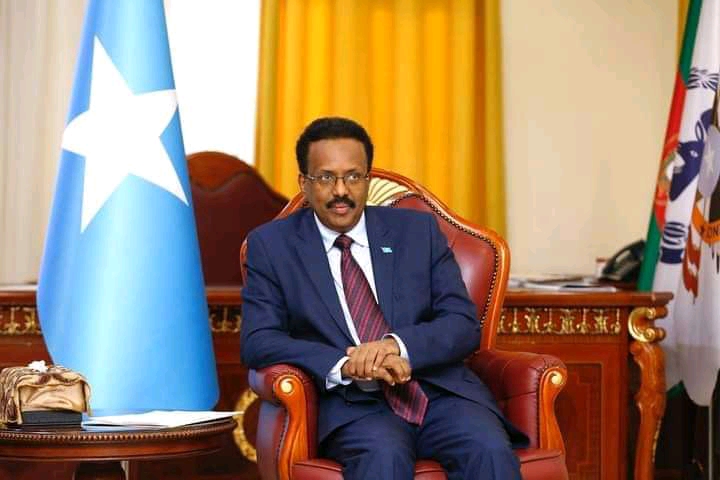
Mohamed Abdullahi Mohamed, widely known as Farmaajo, was born in Mogadishu in early 1962. He completed his secondary education in his hometown before beginning a career in Somalia’s Ministry of Foreign Affairs. Recognized for his diplomatic skills, he was later posted to the Somali Embassy in Washington, D.C., where he gained American citizenship while furthering his education. Farmaajo earned a Bachelor’s degree from the State University of New York (SUNY) at Buffalo in 1993, followed by a Master’s in Political Science in 2009. During his years abroad, he also worked for a decade at the New York State Department in Buffalo, experiences that equipped him with a global perspective, technocratic skills, and a disciplined, reform-minded approach—qualities that would later define his political career in Somalia.
In 2010, Farmaajo was appointed Prime Minister of Somalia by then-President Sheikh Sharif Sheikh Ahmed, a decision welcomed by many Somalis who viewed him as a technocratic leader with integrity and a reputation for discipline. Despite serving only eight months, from October 2010 to June 2011,his tenure was widely praised for its reformist agenda. He introduced civil service reforms that reduced the size of the cabinet from 39 to 18 ministers, improving efficiency and cutting unnecessary costs. Accountability systems and performance standards for ministers and civil servants reinstated discipline within the public sector, while strict attendance and punctuality rules marked a first in many years of instability.
Farmaajo also implemented significant anti-corruption measures, ensuring that government employees and the Somali National Army received regular, audited salaries, restoring public confidence in state institutions. He worked closely with AMISOM (the African Union Mission in Somalia) to strengthen security in Mogadishu and surrounding areas. His leadership style was nationalist and transparent, earning him strong support among ordinary citizens and the Somali diaspora. By promoting unity and national identity, rebuilding public institutions, and enhancing cooperation with international partners such as the UN, the African Union, and neighboring countries, Farmaajo solidified his reputation as a principled and reform-minded leader.
In February 2017, several years after his notable tenure as Prime Minister, Farmaajo returned to the political stage, this time as the President of Somalia. His election came at a moment of renewed national hope, as many Somalis remembered his earlier record of discipline and reform. Citizens across the country and in the diaspora saw his victory as the beginning of a new era, one that promised accountability, unity, and progress. Drawing on his diplomatic experience and technocratic background, Farmaajo worked to strengthen national institutions, improve security, and promote transparency. His presidency reflected the same values that had defined his earlier leadership: integrity, nationalism, and a commitment to serving the Somali people. To this day, Farmaajo remains a respected and influential figure, admired for his steadfast leadership and love for his country. For many Somalis, he continues to embody the hope of a stronger, more united Somalia, and his potential return to office is seen as a chance to rekindle that vision.
During his five-year term, President Farmaajo focused on strengthening national sovereignty, rebuilding security forces, and restoring the country’s financial credibility. His administration is widely credited for taking bold steps toward reducing foreign dependency and reaffirming Somalia’s authority over its own affairs.
One of Farmaajo’s most significant achievements was reforming the Somali National Army (SNA). His government initiated crucial restructuring efforts to create a more disciplined and unified national force, capable of reclaiming territories from al-Shabaab militants. These efforts laid the groundwork for Somalia’s gradual security transition away from African Union forces. Economically, Farmaajo’s leadership marked a turning point. Under his administration, Somalia reached the Heavily Indebted Poor Countries (HIPC) decision point, allowing the nation to qualify for debt relief from international lenders for the first time in decades. His government also introduced financial reforms aimed at improving transparency, fighting corruption, and modernizing public institutions.
In foreign policy, Farmaajo adopted a neutral, Somalia-first approach, avoiding alignment in regional rivalries while maintaining strong diplomatic relations with key partners such as Turkey and Qatar. His firm stance on sovereignty earned him both regional respect and domestic admiration. Infrastructure development also gained momentum during his tenure, with improvements made to Mogadishu’s port, airport, and key road networks, contributing to increased economic activity and mobility within the capital. Beyond policies and projects, Farmaajo’s presidency became a symbol of renewed national pride. His message of unity, accountability, and self-reliance resonated deeply with Somalis both at home and across the diaspora.
Though his term ended in 2022, the sense of optimism he inspired continues to echo among many citizens. For countless Somalis, Farmaajo remains a leader who dared to envision a stronger, more independent Somalia and whose era reignited faith in the nation’s potential for progress. All of these achievements and his unwavering commitment to Somalia earned him widespread admiration, cementing his reputation as one of the most popular and deeply loved presidents in the nation’s recent history. As Somalia approaches the next election, Farmaajo is widely recognized as the strongest candidate and hope of the Somali people!


